
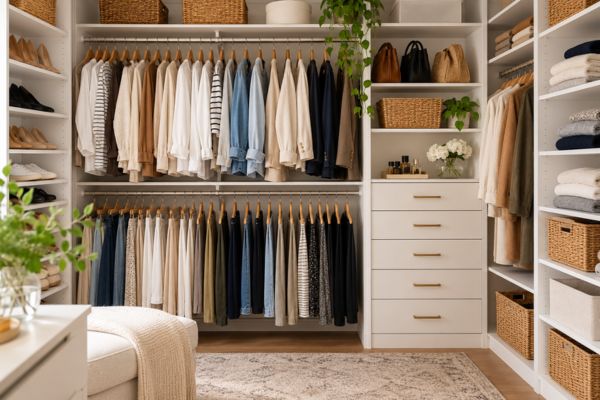
How to Organize Your Closet: A Step-by-Step Guide to Creating a Closet That Works
If opening your closet feels more overwhelming than inspiring, it may be tempting to start with new hangers, matching bins or a better shoe rack.
But organizing your closet doesn't start with organizing.
It starts with understanding what you own, what you actually wear and what deserves space in your closet today.
A beautifully organized closet filled with clothes you don't wear is still a closet that doesn't work.
The goal isn't simply to make your closet look better. It's to create a space where you can see what you own, find what you need and get dressed with less frustration.
That requires working in the right order.
How Do You Organize a Closet?
The most effective way to organize a closet is to first remove what no longer belongs, group the remaining wardrobe into logical categories, evaluate how much space each category requires, and then create an organization system around the clothes you actually wear.
The process looks like this:
Understand what's making the closet difficult to use.
Remove items that don't belong in the space.
Edit your wardrobe before organizing it.
Group what remains into categories.
Evaluate the amount and type of storage you need.
Give every category a logical home.
Add organizing products only where they solve a specific problem.
Create simple systems you can maintain.
That order matters.
When you buy organizers before editing your wardrobe, you're designing a system around everything you've accumulated rather than around the wardrobe you actually want to use.
Step 1: Start With the Problem, Not the Products
Before pulling everything out of your closet, spend a few minutes identifying what's actually frustrating you.
Maybe you can't see your clothes. Perhaps your shoes are scattered across the floor. Your handbags may be piled on a shelf, your drawers may be overflowing, or you may have plenty of clothing but still struggle to put outfits together.
Those are different problems, and they don't necessarily have the same solution.
Ask yourself:
What frustrates me most when I get dressed?
What can I never seem to find?
Which areas of the closet become messy first?
What do I own too much of?
What do I avoid wearing?
Which items don't have an obvious place to go?
Is the problem really storage, or do I simply own too much for the available space?
This quick assessment gives you something far more useful than a Pinterest-perfect vision of somebody else's closet: a definition of what your closet needs to do better.
Step 2: Remove Everything That Doesn't Belong
Closets have a remarkable ability to become holding areas for things that don't have another home.
Before tackling your wardrobe, remove anything that clearly belongs somewhere else.
That might include paperwork, household supplies, empty boxes, luggage, gifts, children's belongings, random returns, décor or items waiting to be donated.
Don't spend hours making decisions about these things yet. Relocate obvious items and create a temporary holding area for anything that requires attention later.
The goal is to uncover the closet's real job: supporting your wardrobe and getting-ready routine.
Once the unrelated clutter disappears, you'll have a much clearer picture of the space you're actually working with.
Step 3: Edit Your Wardrobe Before You Organize It
This is the step people most often want to skip.
Don't.
Organizing clothing you don't wear simply gives unwanted clothing a more attractive place to live.
Go through your wardrobe by category rather than randomly pulling pieces from different areas of the closet. Depending on your wardrobe, categories might include tops, pants, jeans, dresses, jackets, skirts, shoes, handbags and accessories.
For each item, consider four questions:
Do I wear it?
Not could you wear it. Not should you wear it. Do you actually reach for it?
Does it fit your life today?
Your wardrobe should support the life you're living now. Clothing from a former career, previous lifestyle or imagined future can quietly consume an enormous amount of space.
Does it fit and feel good?
Something can technically fit and still never make you feel comfortable or confident enough to wear it.
Would you choose it again today?
This question is particularly useful when guilt gets involved. The fact that something was expensive doesn't mean it needs to occupy your closet indefinitely.
Your goal isn't to get rid of as much as possible. It's to separate the clothing that supports your life today from the clothing that is simply taking up space.
If this is the part of the process where you tend to get stuck, use the Closet Purging Guide in the Closet Confidence Resource Library™ for a more detailed decision-making process.
Step 4: Sort What Remains Into Categories
Once you've edited your wardrobe, resist the temptation to immediately start hanging everything back up.
First, look at what remains.
Group similar items together so you can see the actual size of each category.
For example:
Tops can be separated into sleeveless, short sleeve and long sleeve.
Bottoms might include pants, jeans, skirts and shorts.
Other categories might include dresses, jackets, activewear, sleepwear, shoes, handbags, belts, scarves and jewelry.
The exact categories matter less than whether they make sense to you.
This is also when patterns become visible.
You might discover that you own 24 black tops but very few pieces that work with your favorite pants. Or that handbags occupy an entire shelf even though you regularly carry only three of them.
Organization gives you visibility. Visibility gives you information.
And that information often reveals wardrobe problems that weren't obvious when everything was crowded together.
Step 5: Decide What Should Hang, Fold or Be Displayed
Now you can begin designing the closet around your wardrobe.
Not every piece of clothing needs to be hung, and not everything should disappear into a drawer.
Generally, hanging works well for dresses, jackets, blouses, trousers and clothing that wrinkles easily.
Folding often works better for sweaters, knitwear, activewear, T-shirts, denim and items that may stretch on hangers.
Accessories benefit from visibility. Handbags, jewelry, scarves, belts and shoes are much easier to use when you can actually see your options.
But these aren't rigid rules.
The better question is:
How am I most likely to put this away and find it again?
If carefully folded stacks always collapse into chaos for you, another storage method may work better. If you forget about anything hidden in a drawer, prioritize visible storage for the things you wear frequently.
A successful closet system should work with your habits rather than constantly demanding that you become a different person.
Step 6: Give Your Most-Used Items the Best Real Estate
Not every inch of your closet is equally convenient.
The space between roughly eye and waist level is your prime real estate. Use it for the clothing and accessories you reach for most frequently.
Less frequently used items can move higher, lower or farther away.
Seasonal clothing, special-occasion pieces, sentimental items and occasional accessories don't need to occupy the easiest-to-reach areas of the closet.
Think of your closet like a boutique designed specifically for one customer: you.
The merchandise you want most often should be easiest to see and access.
This simple shift can make a closet feel dramatically easier to use without adding a single shelf.
Step 7: Create a Logical Flow
There is no single correct way to arrange clothing.
The right system is the one that helps you quickly understand what you own.
One effective approach is to organize hanging clothes first by category and then by sleeve length or style. Within those groups, you can arrange items by color if that helps you visually scan the wardrobe.
For example:
Sleeveless tops → short-sleeve tops → long-sleeve tops.
Then within each category:
Light → dark.
You might organize dresses by casual versus dressy, pants by type, or shoes by function.
The point isn't to create a closet that photographs beautifully for five minutes.
The point is to create a visual language that makes sense every morning.
Step 8: Measure Before Buying Organizing Products
Now, finally, we can talk about organizers.
Once you've edited, categorized and assigned general locations, you can see where an organizing product would actually improve the space.
Measure the available width, depth and height before purchasing anything.
Then identify the problem the product needs to solve.
A shelf divider might prevent handbag stacks from collapsing.
A drawer organizer might keep smaller accessories visible.
Matching slim hangers might create more usable hanging space and reduce visual clutter.
A shoe organizer might use previously wasted vertical space.
A tray might keep frequently worn jewelry together.
The product should solve a problem. It shouldn't create a new category of clutter called Things I Bought to Organize My Clutter.
This is also why we recommend organizing first and shopping second.
When you know exactly what needs to be stored and how much space is available, you can choose products intentionally rather than guessing.
Step 9: Make the Closet Easy to Maintain
A closet isn't truly organized if maintaining it requires a weekly restoration project.
The system should make putting something away almost as easy as dropping it on the nearest chair.
Leave breathing room where possible. Overpacked rods, tightly packed drawers and shelves filled to their edges are difficult to maintain because returning one item requires rearranging five others.
Give frequently used categories clear boundaries.
And pay attention to where clutter repeatedly appears.
If shoes always accumulate near the closet door, perhaps shoe storage needs to be closer to the entrance.
If worn-but-not-ready-for-laundry clothes end up on a chair, create a designated place for them.
If empty hangers scatter throughout the closet, establish one place to collect them.
The mess is often giving you useful feedback about where the system isn't working.
What If Your Closet Is Still Too Full?
If you've genuinely edited your wardrobe and the closet still feels crowded, you may be dealing with a space-planning problem rather than an organizing problem.
Look at whether the closet is using its available space effectively.
Is there unused vertical space?
Could one long hanging rod become double hanging?
Are shelves spaced too far apart?
Is there adequate shoe storage?
Are deep corners going unused?
Does the closet configuration match the types of clothing you actually own?
Many closets were built with a basic rod-and-shelf configuration that has very little relationship to the wardrobe stored inside them.
That's where closet design enters the conversation.
Before investing in a custom system, however, understand your wardrobe first. The best closet isn't necessarily the one with the most shelves and drawers. It's the one designed around what you own and how you use it.
Our Closet Design resources can help you evaluate your wardrobe and space before you begin making design decisions.
Common Closet Organizing Mistakes
Several mistakes repeatedly make closets harder to manage.
Buying containers first
Beautiful bins can't compensate for too much stuff or the wrong storage configuration.
Organizing everything you own
Editing is part of organizing. You don't need to find a home for something simply because you already own it.
Creating categories that are too complicated
If maintaining the system requires remembering whether a shirt belongs in “casual elevated basics” versus “weekend smart casual,” the system probably isn't going to survive Tuesday morning.
Prioritizing appearance over function
A boutique-style closet should be beautiful, but beauty comes after usability.
Ignoring how you actually get dressed
Your closet should reflect your routines, wardrobe and habits, not somebody else's organizing system.
Filling every available inch
Empty space isn't wasted space. A little breathing room makes clothing easier to see, retrieve and return.
What Should an Organized Closet Feel Like?
A well-organized closet doesn't have to be enormous, custom-built or filled with expensive organizing products.
It should give you clarity.
You should be able to walk in and quickly understand what you own. Your everyday clothing should be easy to access. Categories should make sense. Items should have obvious homes. And putting things away shouldn't feel like solving a puzzle.
Most importantly, your closet should support getting dressed.
Because organization isn't really about matching hangers.
It's about removing the friction between owning clothes and actually enjoying wearing them.
Start With What Deserves the Space
If your closet feels overwhelming right now, don't try to solve everything at once.
Start before the organizing.
Start by deciding what belongs.
Once you're working with clothing that fits your life, your body, your style and your priorities today, organizing becomes much easier. You aren't trying to squeeze an accumulated wardrobe into a finite space anymore. You're creating a home for the wardrobe you actually use.
And that's when the closet begins to change from a storage problem into something much more useful: a space that helps you get dressed with greater clarity and ease.
Ready to Start?
Explore the Closet Organization resources in the Closet Confidence Resource Library™ for practical guides and tools that can help you declutter, organize and create a closet that works for the way you live today.